

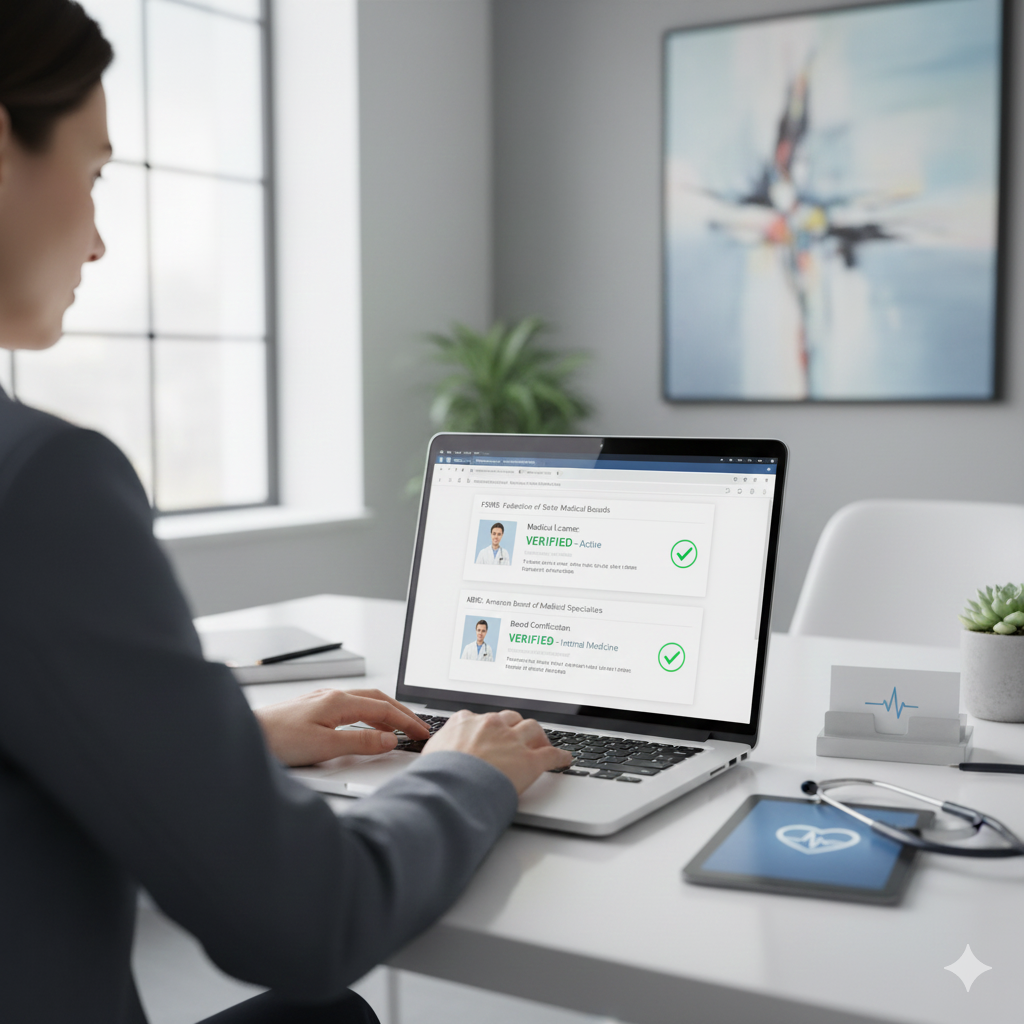

Verify doctor credentials
Verify doctor credentials before booking any appointment in 2025 to ensure your doctor is licensed, board-certified, and trustworthy. With the rise of telehealth and globalized healthcare, taking a few minutes to check your provider’s background can protect your health and peace of We trust doctors with our most valuable asset: our lives. When you walk into a clinic or log on for a telehealth appointment, you operate under the assumption that the person on the other side is qualified, licensed, and competent. For the most part, this trust is well-placed. However, the digital age has made it easier for credentials to be exaggerated—or in rare cases, completely fabricated.
As we move through 2025, verify doctor credentials, the rise of telemedicine and globalized health services means you might never meet your specialist in person. This distance makes verification more critical than ever. Relying solely on a framed diploma on a wall or a polished website bio isn’t enough. You need concrete proof that your provider is who they say they are.
Taking the time to investigate a provider’s background isn’t about being paranoid; it is about being a proactive participant in your own well-being. By understanding how to navigate public databases and official records, you can ensure that you and your loved ones receive care from legitimate professionals.
Why You Should Verify Doctor Credentials
Most patients spend more time researching a new car or a vacation rental than they do investigating their medical providers. While personal referrals and online reviews are helpful, they don’t tell the whole story. A doctor can have a five-star personality but a suspended license.
Safety and Competence
The primary reason for verification is safety. Licensing ensures that a doctor has completed the necessary medical school training, residency programs, and exams required to practice medicine safely. Without a valid license, there is no guarantee that the individual has the medical knowledge to diagnose or treat you. verify doctor credentials
Avoiding Fraud
While rare, medical imposters do exist. These are individuals practicing without a license or practicing outside the scope of their training. More commonly, legitimate doctors may continue to practice despite having their licenses restricted due to substance abuse, negligence, or criminal behavior. Verifying credentials helps you spot these issues before you book an appointment. verify doctor credentials
Matching Specialization to Needs
When choosing a physician, you want to ensure their expertise aligns with your specific condition. A general practitioner is excellent for overall wellness, but if you need complex cardiac surgery, you need to confirm that your surgeon is specifically trained and certified in that field. Verification confirms that their marketing claims match their actual training.
Key Organizations for Online Verification
Before you start your search, you need to know where to look. The internet is full of third-party “doctor rating” sites, but these are marketing platforms, not official verification bodies. For accurate data in 2025, stick to these three authoritative sources. verify doctor credentials
Federation of State Medical Boards (FSMB)
The FSMB is a national non-profit representing the medical boards of the United States. Their consumer-facing tool, DocInfo.org, is invaluable. It aggregates data from various state boards, allowing you to see a doctor’s disciplinary history and license status across state lines. This is particularly useful if a doctor has moved from one state to another to hide a troubled past.
American Board of Medical Specialties (ABMS)
If a doctor claims to be a specialist (e.g., a dermatologist or cardiologist), you should verify if they are board certified. Certification via an ABMS member board is a voluntary process that goes beyond basic licensing. It demonstrates that the physician has achieved expertise in a specific specialty and participates in ongoing education. You can check this status on CertificationMatters.org.
State Medical Boards
Every state has its own licensing board that regulates medical practice within its borders. These state websites are often the most up-to-date sources for recent disciplinary actions or license suspensions. If your doctor practices in Texas, for example, the Texas Medical Board website is your primary source of truth. verify doctor credentials
Step-by-Step Checklist for verify doctor credentials Online
Navigating the health care system can be complex, but verifying a doctor doesn’t have to be. Follow this checklist to get a clear picture of your provider’s professional standing.
1. Gather the Basic Information
Before you search, make sure you have the correct spelling of the doctor’s first and last name, and the city and state where they practice. Common names like “John Smith” will return hundreds of results, so having the middle initial or specific practice location helps narrow down the search.
2. Check the State License Status
Start with the state medical board website where the doctor practices. Search their name and look for the license status. You want to see “Active” or “Clear.”
- Active: The doctor is currently allowed to practice.
- Inactive/Expired: They are not currently licensed in that state.
- Suspended/Revoked: The state has stopped them from practicing due to a violation.
- Probation: They are allowed to practice but under supervision or specific conditions due to a past issue.
3. Confirm Board Certification
Being board certified is a gold standard in modern medicine. It indicates the doctor has passed rigorous exams in their specialty. Visit the ABMS website to confirm their certification is current. Note that certification serves a different purpose than licensing; a doctor can have a valid license but not be board certified. However, for specialized care, certification provides an extra layer of assurance regarding their competence.
4. Review Disciplinary Actions
This is the step most patients skip, yet it is the most revealing. Look for a section on the state board or FSMB profile labeled “Public Board Actions” or “Disciplinary History.” This section will detail malpractice settlements, criminal convictions, or administrative actions taken against the doctor.
Pay attention to the severity of the action. A small administrative fine for paperwork errors is very different from a suspension for patient negligence.
5. Verify Hospital Affiliations
Most qualified doctors have admitting privileges at local hospitals. This means a hospital has vetted them and allows them to treat patients there. You can usually verify this on the doctor’s profile or by cross-referencing with the hospital’s staff directory. If a doctor has no hospital affiliations, ask why. It might be normal for a dedicated telemedicine provider, but it is a red flag for a surgeon.
Red Flags to Watch Out For
During your research, certain warning signs should trigger immediate caution. verify doctor credentials If you encounter any of these, pause and investigate further before scheduling an appointment.
Frequent Moves Between States
Doctors move for legitimate reasons, such as family or better job offers. However, a pattern of moving states every couple of years can sometimes indicate “jurisdiction hopping”—moving to a new state to leave a bad record behind. Always check the license history in every state where they have practiced.
Discrepancies in Education
If the medical school listed on their website doesn’t match what is listed in the state board database, be wary. verify doctor credentials While it could be a simple clerical error, it could also be an attempt to inflate credentials.
Lack of Transparency
Legitimate medical professionals have nothing to hide. If you ask a doctor about their board certification or hospital privileges and they become defensive or give vague answers, consider it a major warning sign. In 2025, transparency is a standard expectation in medicine.
“Board Certified” by Unknown Boards
Not all medical boards are created equal. Some doctors may claim certification from self-designated boards that do not require the same rigorous testing as the ABMS member boards. Always research the certifying organization if you haven’t heard of it.
Empowering Patients Through Due Diligence
The dynamic of the doctor-patient relationship is shifting. You are no longer a passive recipient of care; you are a consumer of high-stakes services. By taking the time to verify credentials, you protect yourself from potential harm and ensure you are partnering with a qualified professional.
In an era where misinformation spreads instantly, truth is your best defense. Use the tools available to you. Check the license. Confirm the certification. Ask the hard questions. Your health is worth the extra effort.